
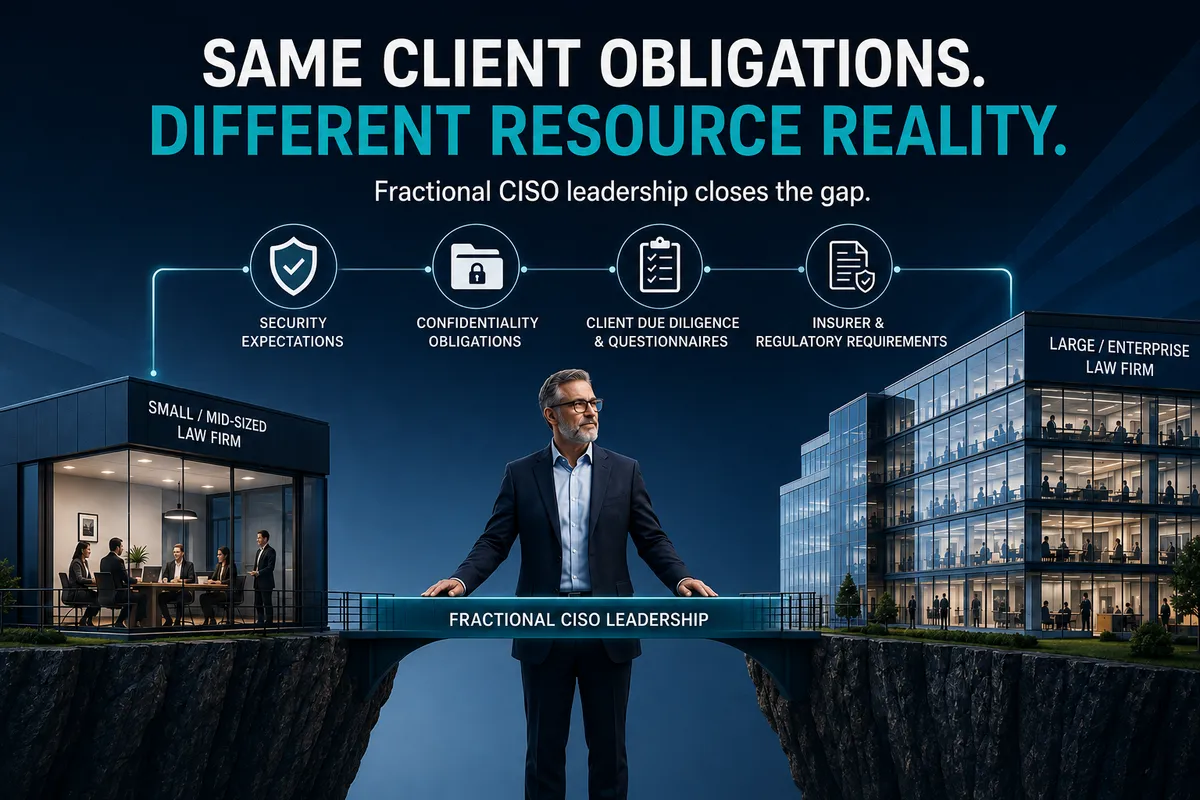
Same Client Obligations, Different Resource Reality
Small and mid-sized law firm often serve the same corporate clients, insurers, and regulated industries as a much larger firm, and as a result are held to the same client-imposed security requirements, outside counsel guidelines, and ethical obligations. A regional bank, insurer, or healthcare system does not relax its vendor security questionnaire or its expectations around financial oversight because the firm handling its matters has 20 attorneys instead of 200. What differs is not the obligation, but the resourcing: smaller firms rarely have the budget or deal flow to justify a full-time Chief Information Security Officer (CISO) dedicated to meeting those same expectations.
This central resourcing gap is what the fractional executive model is built to close. It allows a smaller firm to meet the same client, insurer, and regulatory expectations as its larger competitors, without carrying the fixed cost of full-time executive headcount that only a larger firm's client volume can support. Firm administrators remain essential for day-to-day execution, but the strategic and governance components of information security, compliance and risk management require specialized senior expertise most small firms cannot economically staff on a full-time basis
The Strategic Gap
Cybersecurity governance corporate clients and cyber insurers now routinely require documented security programs, incident response plans, and named accountable leadership obligations an IT support vendor or administrator is not trained or positioned to own. These rigorous and escalating requirements can push firms to the point where client and regulatory expectations outpace what attorney leadership and an administrator can comfortably cover.
By engaging a fractional executive, the administrator remains central to execution, while the fractional executive supplies the senior judgment and accountability that client and regulatory expectations demand, but the firm cannot economically staff full-time.
The Case For Fractional Leadership
Meeting Enterprise-Level Expectations at Small-Firm Scale
Fractional engagements exist because they let a smaller firm meet the same client security questionnaires, outside counsel guidelines, and financial governance standards that large firms meet with full-time staff, at a cost structure a smaller client roster can actually support. Fractional CISO engagements for smaller firms often range from 4,000 to 8,000 dollars per month, versus 300,000-plus dollars annually for a full-time security executive. The firm is not settling for a lesser standard. Instead, it is reaching the same standard through a different resourcing model.
Legal-Industry Fluency as a Differentiator, Not a Nice-to-Have
A fractional CISO with deep legal industry experience brings something a general-purpose security or financial provider cannot: fluency in how law firms actually operate and what they owe their clients. This includes an understanding client confidentiality obligations, attorney ethical duties around safeguarding client information, and privilege considerations that a generalist security vendor is simply not trained to weigh.
A general-purpose security provider can harden systems and pass a technical audit, but a legal-industry fractional CISO understands that a law firm's security program exists in service of a broader professional obligation.Protecting client confidence is not just an IT control, it is a core ethical duty under the rules of professional conduct governing attorneys. That fractional leader frames every security decision, from vendor selection to incident response, around the question of what stewardship of client information actually requires, not merely what a generic compliance checklist demands.
A legal-industry fractional CISO is in touch with the connection between stewardship and client service and retention. A firm that integrates these concepts into their core values have a powerful position to highlight when responding to RFP’s and during other client acquisition opportunities.
Stewardship as the Organizing Principle
Law firms hold a unique position of trust: clients share privileged, sensitive, and often critical business information with the expectation that the firm will protect it as a matter of professional duty, not just contractual obligation. A fractional executive with legal industry experience internalizes this stewardship mindset and applies it: a fractional CISO treats client data with the weight of an ethical obligation, not just a technical asset to be secured. This orientation shapes how decisions get made, prioritized, and communicated to both partners and clients.
A Force Multiplier for the Firm Administrator
A fractional executive typically elevates the administrator's role rather than competing with it—providing strategic direction the administrator can implement and mentoring administrative staff along the way. Firm administrators often welcome this relationship because it gives them senior support and cover for decisions that exceed their authority or training, rather than adding to their workload.
Scalability and Lower Hiring Risk
Engagement hours can expand during a merger, new corporate client onboarding, or a heightened security due diligence request, then contract once the initiative stabilizes, without renegotiating an employment contract. This flexibility, paired with the lower risk of a reversible engagement compared to an expensive full-time mis-hire, gives attorney and administrative leadership a lower-stakes way to test what senior strategic support delivers before committing to a permanent role.
Credibility With Clients and Insurers
A documented cybersecurity governance program, built and overseen by a named fractional CISO who understands legal ethical obligations, working alongside IT support and the firm administrator, has become a competitive differentiator in corporate client security questionnaires and cyber insurance underwriting. Firms without this structure risk losing institutional client relationships to competitors, regardless of size, or facing higher insurance premiums, making this a business development and risk-transfer issue for attorney leadership, not simply a technical task for the administrator's office.
Capacity to Comply
An additional benefit of a documented cybersecurity governance program is that it helps attorneys fulfill the oblication to provide demonstrable evidence of oversight. The incredibly dynamic arenas of cybersecurity, risk management, and governance are increasingly voluminous and fast paced. Maintaining a sufficient level of fluency to oversee these functions as an on-the-side duty is increasingly stressful and difficult. Engaging a fractional CISO brings a subject matter expert to your team without C level expense.
Where the Model Falls Short
Divided Attention During Urgent Matters
A fractional executive serving multiple clients is not on-site when a security incident occurs after hours or when a same-day operational decision is needed, which can leave the administrator managing a crisis without immediate senior guidance. Firms with fast-moving, high-stakes operational needs should factor in response-time expectations before engaging.
Not All Legal-Industry Experience Is Equal
The value-add of legal fluency depends entirely on the depth of that experience; a provider who merely lists "law firm clients" on a website without genuine understanding of trust accounting, ethical duties, or privilege considerations offers little advantage over a general-purpose provider. Firms should vet this claim directly rather than accepting it at face value.
Unclear Reporting Lines and Scope Creep
Confusion about whether the fractional executive reports to the managing partner, an executive committee, or the firm administrator (or holds real decision-making authority versus advisory-only status) is the most common reason these engagements underdeliver. Firms and fractional executives should explicitly define how the fractional leader and the administrator divide responsibility and who has final sign-off on decisions in each function.
Firm Size and Complexity Threshold
Very small firms with minimal client-imposed obligations and a lean administrative function already covering most needs may not have the complexity to justify even a fractional executive; a periodic external assessment may be more cost-effective. Firms should assess this honestly against their actual client requirements and their administrator's current bandwidth.
Continuity Risk at Engagement End
If a fractional engagement ends without a transition plan, the administrator can be left executing against a strategy or security program with no one maintaining or updating it, creating a risk for cybersecurity governance, which requires ongoing oversight to remain credible to clients and insurers, not a one-time build.
Pros and Cons Summary
Considerations
Enterprise-level security leadership
Advantage
Meets the same client and insurer expectations as larger firms without full-time headcount cost
Risk to Manage
Premium rates if scope expands beyond the original engagement
Legal industry fluency
Advantage
Understands ethical duties, confidentiality, and stewardship obligations unique to law firms
Risk to Manage
Not all providers with "legal experience" have genuine depth—requires vetting
Fit with existing staff
Advantage
Elevates and directs the firm administrator's work rather than duplicating it
Risk to Manage
Unclear reporting lines between fractional executive and administrator can cause friction
Flexibility
Advantage
Scales up for growth, mergers, or new client security requirements
Risk to Manage
Divided attention across multiple clients can slow urgent decisions
Client and insurer trust
Advantage
Strengthens RFP responses and cyber insurance underwriting positioning
Risk to Manage
Value depends on ongoing maintenance, not a one-time build
Risk profile
Advantage
More reversible than a bad full-time executive hire
Risk to manage
Leadership and program continuity risk if engagement ends without a handoff plan
Getting the Structure Right
To obtain genuine value from fractional leadership, firms take a few deliberate steps before engaging. Attorney leadership and the firm administrator should jointly define the fractional executive's scope and authority in writing, clarifying which decisions the executive can make directly, which require partner sign-off, and how the executive's direction flows through the administrator's day-to-day work. This joint framing matters: firms should position the engagement to the administrator as strategic support and professional development, not oversight or replacement, to preserve trust and cooperation.
When evaluating candidates, firms should specifically probe for legal industry depth rather than accepting general claims of relevant experience. This can be accomplished by asking how a prospective fractional CFO has handled trust accounting oversight or how a prospective fractional CISO has navigated client confidentiality obligations and privilege considerations in a security incident. This reveals whether the stewardship mindset is genuine or superficial. Both attorney and administrative leadership should agree on specific, measurable outcomes (improved external security ratings, a completed incident response plan, faster turnaround on client security questionnaires) rather than vague goals like "better operations" or "stronger security".
Finally, before signing, both attorney leadership and the administrator should discuss the end state of the engagement. This could be in the form of an eventual full-time hire, continued fractional support, or a defined handoff of responsibilities back to internal staff. This positions the firm to avoids a disruptive gap when the contract concludes. For firms evaluating a fractional CISO, aligning the engagement with client security questionnaire timelines, cyber insurance renewal cycles, and applicable regulatory and ethical obligations ensures both the partners and the administrator see the investment as tied directly to client trust, business development, and professional responsibility—not just a technical add-on.
For a more in-depth and collaborative examination of what a fractional CISO role might look like at your firm, contact David Oxley to schedule an exploratory conversation.
OXLEY CYBER ADVISORS:
PROTECT THE DATA | PROTECT THE CLIENTS | PROTECT THE FIRM
