
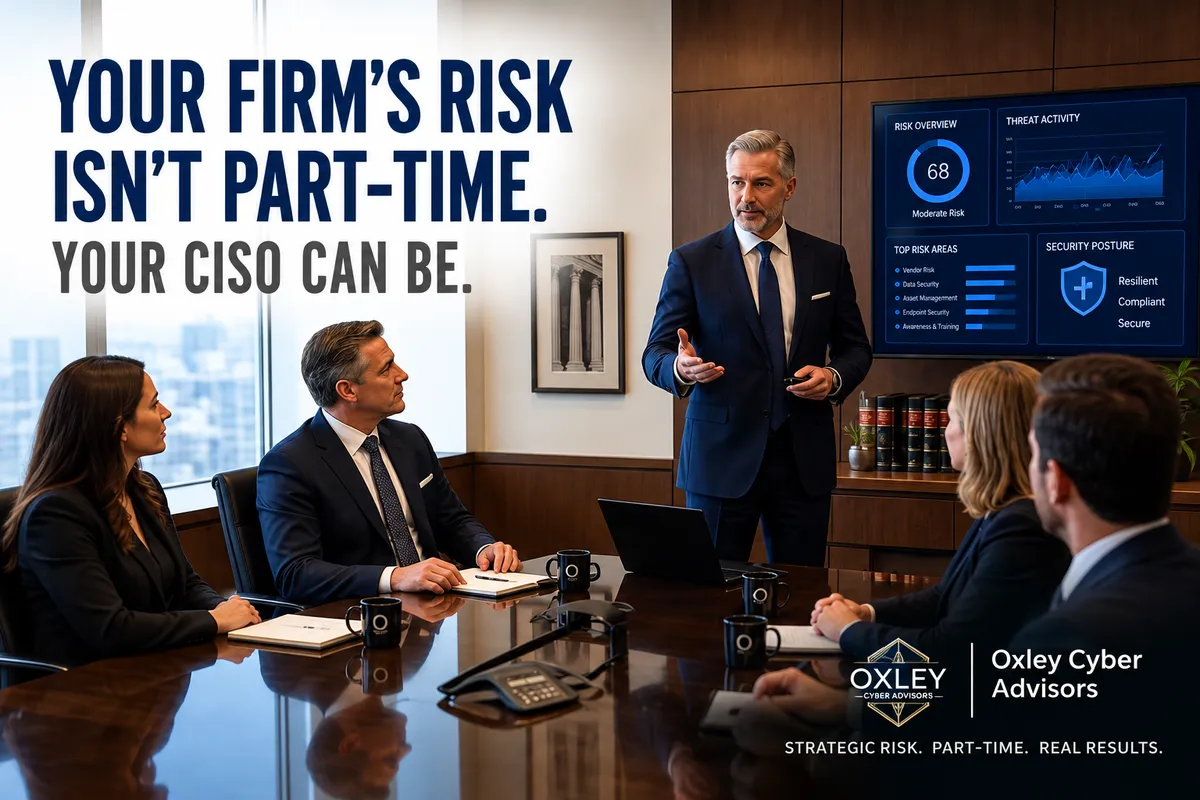
Your Firm's Risk Isn't Part-Time. Your CISO Can Be.
A law firm can have the same clients, confidentiality obligations, and business risks as a much larger firm, without having the budget for a full-time security executive.
That gap is where fractional leadership can help. A fractional executive brings senior-level experience into the firm on an ongoing, part-time basis, giving leaders a practical way to get executive guidance without carrying the cost of a full-time C-level salary.
This can be especially useful in information security and governance. A fractional Chief Information Security Officer, or CISO, is more than a consultant who delivers a report and moves on. The fractional CISO works as part of the leadership team, typically in an ongoing 1099 engagement, helping establish strategy, advise decision-makers, and guide the firm’s security program over time.
For a law firm, that means having someone who can translate security and risk into business terms. Partners and boards need to make decisions about priorities, investment, client expectations, and the firm’s tolerance for risk. A senior security leader can help frame those decisions, explain the tradeoffs, and connect them to the firm’s responsibilities to clients and its long-term business interests.
The work is not just about recommending tools. A fractional CISO can help set a practical roadmap, clarify ownership, and guide the firm through steady improvements. That also helps the firm demonstrate that security is being actively overseen, rather than treated as a one-time project or something left entirely to IT. This enhanced oversight extends to business partners as well, a CISO can monitor the security performance of your managed service providers, positioning an experienced resource to ensure your service providers are developing an appropriate security posture for your firm. Good governance gives leaders a clearer picture of what is being done, what still needs attention, and where limited resources are best spent.
The fractional executive model can also provide continuity and perspective that are difficult to get from short-term advice alone. A trusted executive partner learns the firm’s priorities, participates in leadership conversations, and helps keep important work moving between meetings. The firm retains control of its decisions while gaining experienced counsel that may otherwise be out of reach.
At Oxley Cyber Advisors, we work with small and midsize law firms as a fractional CISO resource, bringing security leadership into the business conversation. That includes helping leaders make sense of emerging issues such as artificial intelligence (AI), set reasonable governance expectations, and consider how new tools affect client confidentiality and risk. The goal is thoughtful decision-making, not alarm or a promise that risk can be eliminated.
Have you considered a fractional executive for your firm, particularly for information security or governance? I’d be interested to hear what has made the model appealing, or what questions you would want answered before bringing someone into the leadership team.
